
Dentures
Dentures
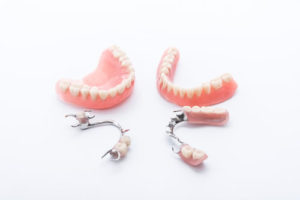 Dentures are an easy way to quickly and economically replace multiple missing teeth. Modern dentures are more comfortable and natural looking than those of your grandparents.
Dentures are often made using either a metal or plastic framework. Each have their own advantages and the best outcome will depend on the health of the remaining teeth.
A well-made denture can be a fantastic solution, but can take some getting used too. If you have a denture but still find yourself struggling to keep it in place or if it is negatively affecting your life, there are now other options.
Implant Retained Removable Denture
Today dentures are often fixed or held in place with 2 or more dental implants. This gives the advantage of being able to remove the denture for cleaning, but with the stability and security of knowing it’s held in place whilst eating, speaking and laughing.
Permanent Implant Denture/Bridge
If you don’t like the idea of taking your teeth in and out of your mouth, dental implants can again be used to hold permanent replacement teeth in place. Whether its replacing just the missing teeth on one side of your jaw or all of your teeth, its often possible to have permanent teeth again.
What Option Is Best For Me?
Deciding which options are available and which is the best option for you will often require a 3D x-ray scan of your jaw. These scans are unfortunately not covered by Medicare and generally cost about $150 at your local radiology clinic. It is important to realise that dental implants are not a suitable solution for all people, but they are not the only solution. If you would like to know more information on what your options are, please contact us for an appointment.
 We would all love to be able to grow new teeth. The only problem is it takes our bodies about 6 years to grow our first adult teeth. Dental implants look and feel like a natural tooth and can truly change the way people live. Dental implants can give people back the confidence to eat, laugh, speak and enjoy life. If you have gap in your smile, or an unreliable denture, it might be the solution for you.
 When decay in a tooth is left untreated, the bacteria causing the decay will eventually reach the nerve in the centre of the tooth and infect it. An infected tooth nerve can be extremely painful. After the infection has killed the tooth nerve, the pain momentarily disappears. It is not unusual for patients to be able to tell us the exact time the tooth nerve died, as the pain goes from 9/10 to almost nothing. The infection then continues to spread into the jaw bone, with a slowly increasing debilitating pain.
 A dental crown wraps up a tooth to protect it from cracking or splitting in much the same way as a phone case prevents a dropped phone from cracking. A dental crown is a good solution to strengthen a tooth, when 50% or more of the tooth structure has already been lost. They can also be used to hold together a tooth, which has already badly cracked. Dental crowns are a great way to restore a tooth to a beautiful natural look and feel.